
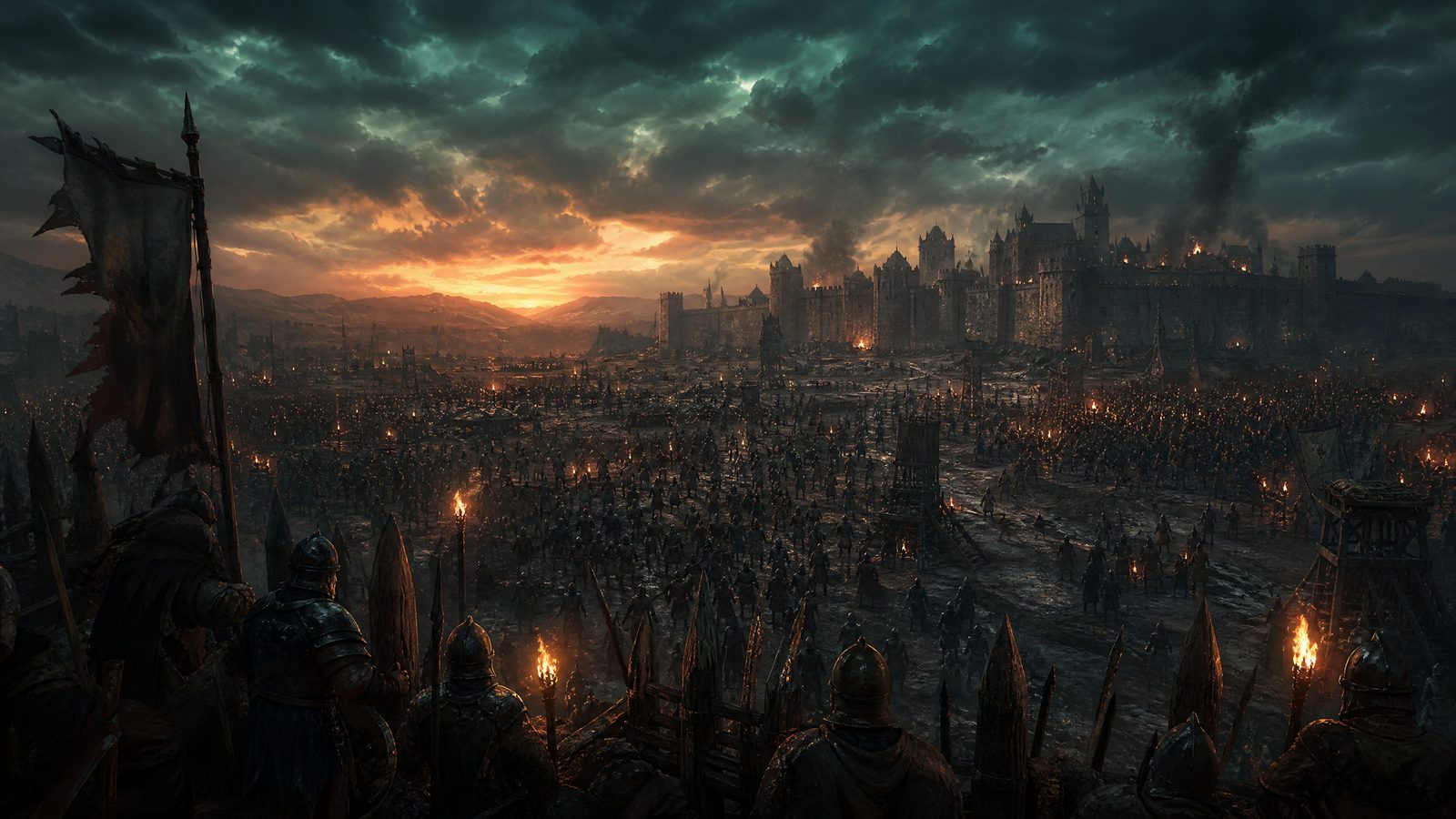
Stand on the palisade at the top of a Banner Fields siege and you are looking at something no other game in our archive can produce. Four hundred players, mostly on foot, arranged in formations that hold because people want them to hold, moving across a mile of churned mud toward a wall somebody built by hand.
Then a man in front of you swings an axe, the animation plays, and you die four metres to his left because the server had not yet been informed that either of you had moved.
Ten ticks is a hundred milliseconds of not knowing
At ten updates per second the server resolves the world once every hundred milliseconds. A sword swing in this game has a wind-up of a hundred and eighty milliseconds and an active hit window of roughly seventy. That window is smaller than the interval between the server's opinions about where your body is.
Add our median round-trip time of thirty-four milliseconds in the near region and the peek advantage — the gap between when an approaching player can see you and when you can see them — reaches two hundred and ten milliseconds. In a game decided by melee timing, that is not a technical shortcoming. It is the outcome being determined by something other than the fight.
| Configuration | Tick interval | Our median RTT | Peek advantage |
|---|---|---|---|
| Near region, fibre | 100 ms | 34 ms | 210 ms |
| Near region, cable | 100 ms | 52 ms | 231 ms |
| Far region, fibre | 100 ms | 141 ms | 329 ms |
| Far region, tether | 100 ms | 244 ms | 438 ms |
What the design needs, and does not get
The frustrating part is that Banner Fields has genuinely good combat design underneath. Directional blocking, a feint that costs stamina, a chambering mechanic that rewards reading an opponent's swing. All of it presumes the server can tell who committed first.
Our testers logged eleven thousand melee exchanges and disputed forty-four per cent of them — meaning the loser could state clearly why the result was wrong and the replay agreed. Forty-four per cent. Slipstream Nine disputes under five per cent of contact events on a deliberately ruined connection.
A chambering mechanic at ten ticks is a lottery with extra steps, and the players who master it are mastering the latency rather than the sword.
Nineteen visible corrections per match
Nineteen. The archive median is three point six. Cavalry teleport, infantry slide sideways, and bodies appear on top of one another during a push. The game does not indicate any of it, so every one of those nineteen events is experienced as either your own error or someone else's cheating.
There is a workaround the community has invented, which is to fight only at the edges of a formation where fewer entities are in flight. It works, measurably — our disputed-melee figure drops to twenty-six per cent in fights with fewer than forty nearby players — and the fact that the optimal strategy is avoiding the game's headline feature should have ended an internal meeting somewhere.
Three regions and no ceiling at all
Three hosting locations against an archive median of four, and no latency ceiling in matchmaking whatsoever. The game will put a player at two hundred and forty milliseconds into the same four-hundred-player siege as a player at fourteen, and neither of them is told.
Verge Squad enforces a hundred and forty millisecond ceiling and makes distant players wait longer for better matches. That is the correct trade and it costs nothing to implement.
| Measure | Banner Fields | Archive median |
|---|---|---|
| Tick rate | 10 Hz | 28 Hz |
| Hosting regions | 3 | 4 |
| Visible corrections per match | 19 | 3.6 |
| Correction indicator | None | None |
| Matchmaking latency ceiling | None | None |
Where it earns its six
Siege engines, which resolve at nine per cent dispute — the lowest figure in the game — because a trebuchet's flight time is long enough that a hundred milliseconds of uncertainty does not matter. Fortification building, which is asynchronous and therefore immune to the problem entirely. And the sheer social spectacle of four hundred people agreeing to stand in a line.
If the game were only sieges and construction it would score in the eights. The melee it is built around is the part the netcode cannot carry.
The short version
- Ten ticks resolving four hundred players in a single battle.
- Peek advantage of two hundred and ten milliseconds on a good line.
- Forty-four per cent of melee exchanges disputed by the loser with cause.
- Nineteen visible corrections per match against a median of three point six.
- Three regions and no latency ceiling in matchmaking.
- Sieges and construction work well; the sword fighting does not.
Verdict
Six point four. Genuinely one of the most impressive things anyone is building, delivered at an update rate that cannot describe its own combat system. Triple the tick rate and halve the player cap and this is an eight-and-a-half — a trade Slipstream Nine made deliberately with eight cars instead of twenty-four.