
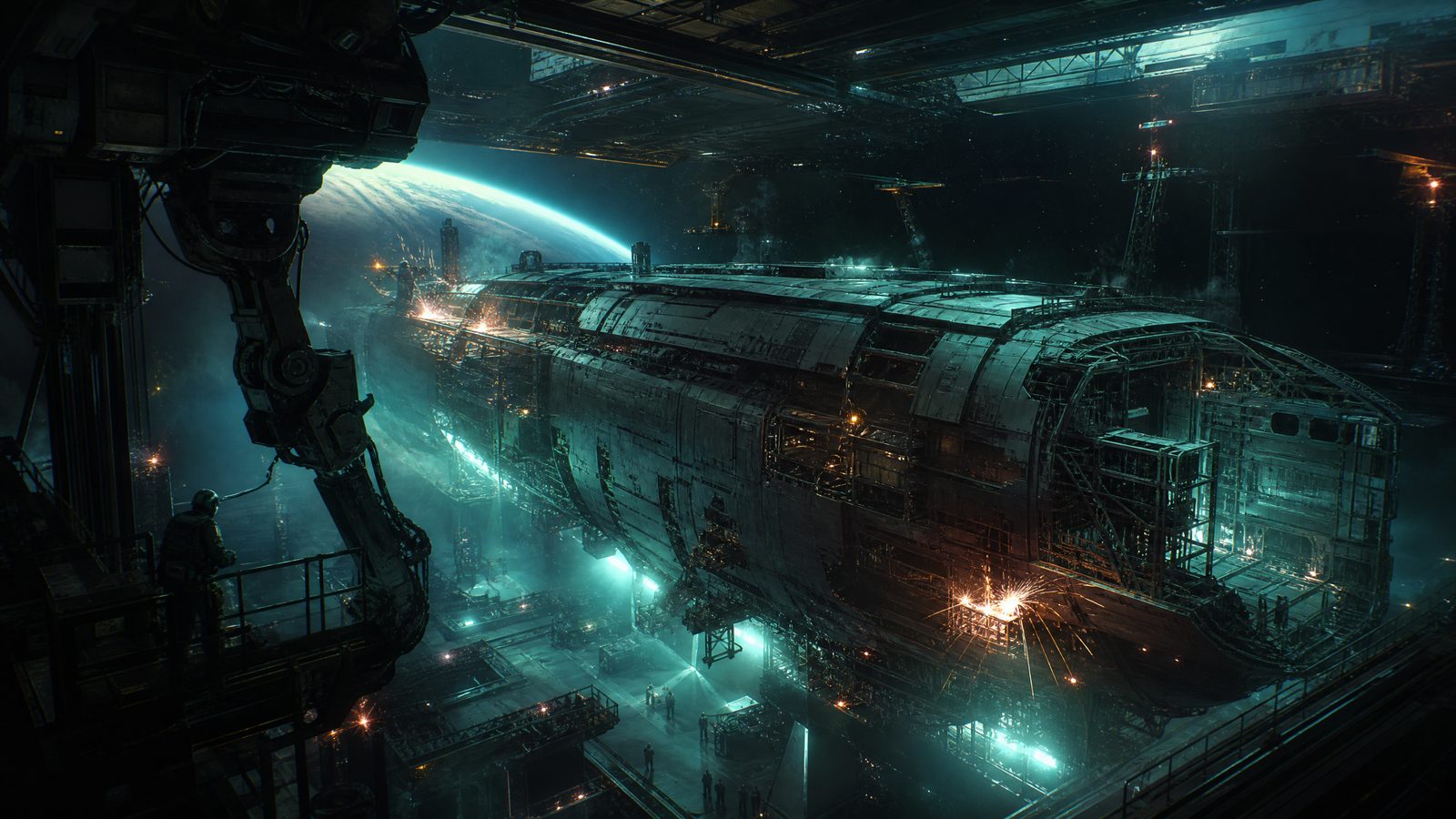
The shipyard is the best thing here. A half-built freighter hanging in a docking cradle, welding sparks falling into nothing, four players arguing about whether the cargo bay is long enough. Dock Nine is unusually good at making industrial work feel consequential, and for most of a session the fifteen-tick update rate is completely irrelevant.
Then somebody calls a fleet action, ninety-odd ships converge on one volume of space, and the server visibly gives up.
A nominal rate and a real one
Fifteen ticks is what we measure with fewer than twenty ships in the area. It is not a fixed budget: the server degrades gracefully rather than dropping players, which is a defensible engineering choice and one we would praise if the game were honest about it.
With more than ninety ships we measured six ticks. An interval of a hundred and sixty-seven milliseconds. Turret tracking, missile locks and point-defence all resolve on that interval, in a battle where the outcome determines control of a station that took a fortnight to build.
| Ships in volume | Measured tick | Interval | Disputed kills |
|---|---|---|---|
| Under 20 | 15 Hz | 67 ms | 6% |
| 20 to 50 | 13 Hz | 77 ms | 11% |
| 50 to 90 | 9 Hz | 111 ms | 24% |
| Over 90 | 6 Hz | 167 ms | 39% |
Why this is worse than Banner Fields, in one respect
Banner Fields is a ten-tick game and always tells you so by feel: it is consistently imprecise, and players calibrate to that. Dock Nine is precise for nine hours and then imprecise for the twenty minutes that decide everything, which is harder to learn and much harder to accept.
Our testers logged more frustration in Dock Nine's fleet battles than in Banner Fields' sieges despite the better nominal figure, and the reason they gave was consistency. You cannot build a skill around a rate that changes with attendance.
A variable tick rate teaches the player nothing, because the lesson changes depending on how many people showed up.
Eight point four corrections, badly placed
Eight point four visible corrections per match, more than twice the archive median, and unlike Bazaar Run they are not confined to movement. Missile locks break and reacquire, turret tracking snaps to a position the target left, and hull damage sometimes arrives in a batch several seconds after the shots that caused it.
There is no indicator. In a hundred-ship engagement it is genuinely impossible to know whether you were outplayed or arbitrated against, which is the exact condition that produces cheating accusations. The forums are full of them and most are wrong for the right reasons.
What earns the seven
Everything outside combat. Construction is asynchronous and never disputed. Hauling contracts are server-authoritative and clean. The station-management layer works at any latency, and from our far test positions the game remained perfectly enjoyable right up until the shooting started.
Four regions, near-region matchmaking, and — unusually — a reconnection window of two minutes that holds your ship in place. Good work, aimed at the right problems, everywhere except the one place it is needed most.
| Measure | Dock Nine | Archive median |
|---|---|---|
| Tick rate, nominal | 15 Hz | 28 Hz |
| Tick rate, loaded | 6 Hz | — |
| Hosting regions | 4 | 4 |
| Visible corrections per match | 8.4 | 3.6 |
| Reconnection window | 2 min | 45 s |
The short version
- Fifteen ticks nominal, six measured in hundred-ship engagements.
- Thirty-nine per cent of kills disputed at the highest ship counts.
- Eight point four corrections per match, and they land on combat rather than movement.
- No indicator, in the one context where players cannot self-diagnose.
- Construction, hauling and station management are all excellent and latency-proof.
- Two-minute reconnection window is better than most of the archive.
Verdict
Seven point three. Nine hours of a good game attached to twenty minutes of an unreadable one, and the twenty minutes are the reason anyone turns up. Cap the engagement, or publish the degradation curve so players can decide when to arrive.